
The Rising Popularity of Crypto Games

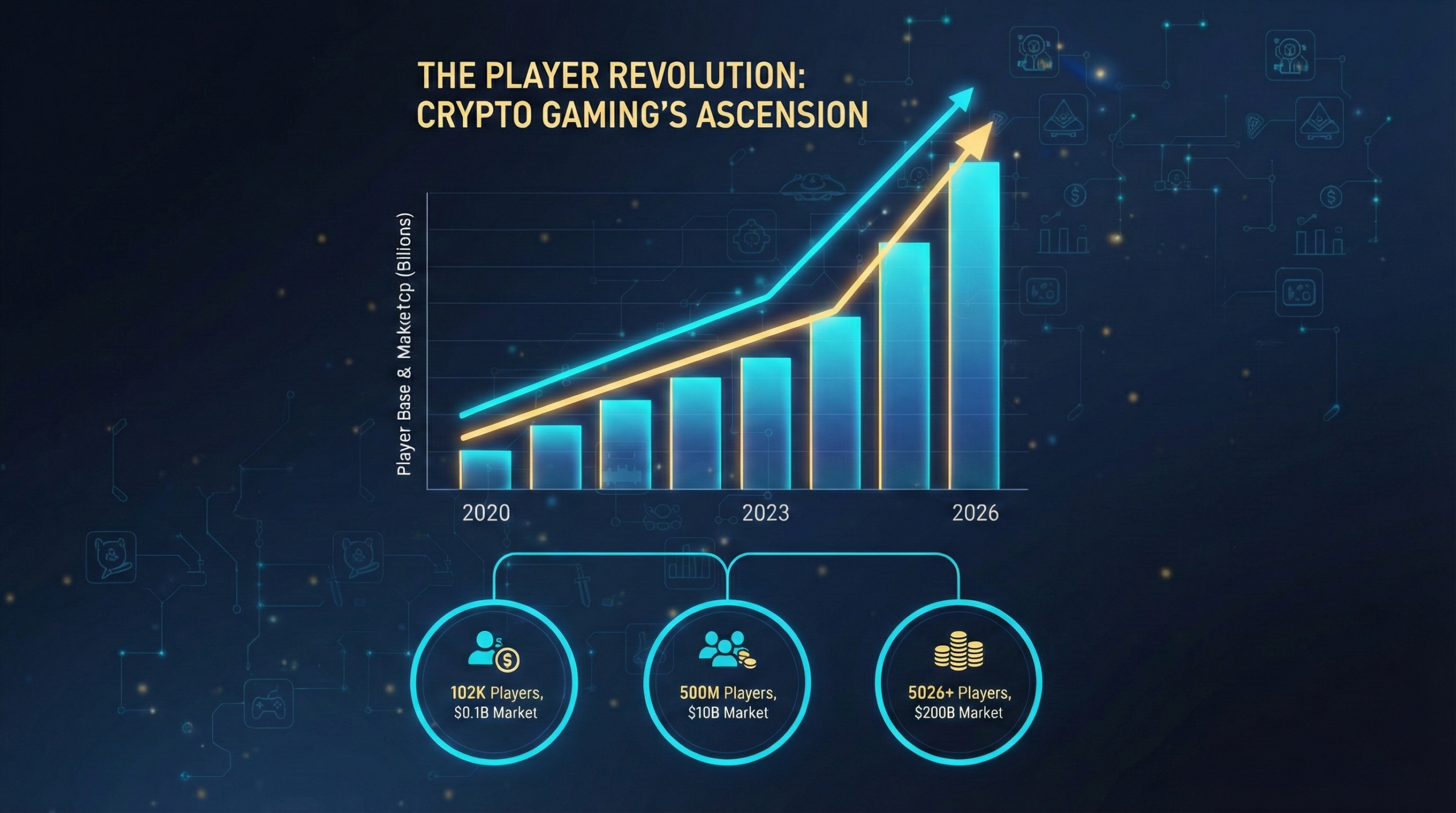
Crypto games, also known as blockchain games, have rapidly evolved from experimental prototypes into one of the fastest-growing segments of the global gaming industry. By combining traditional gameplay with on-chain ownership, tokenized economies, and decentralized marketplaces, crypto games are reshaping how players interact with digital worlds and extract value from play.
Once dismissed as speculative or overly complex, crypto games in 2025 now attract tens of millions of active users worldwide. Improvements in user experience, mobile accessibility, and sustainable game economies have fueled this growth, positioning crypto gaming as a long-term pillar of interactive entertainment rather than a passing trend.
Market Performance and Key Growth Milestones
Experimental foundations (2017–2020)
The earliest crypto games, such as NFT-based collectibles and simple browser games, proved that digital asset ownership could exist on-chain. However, slow networks, high transaction fees, and shallow gameplay limited adoption to crypto enthusiasts.
Play-to-earn explosion (2021)
During the 2021 crypto bull market, play-to-earn (P2E) games reached mainstream visibility. Millions of users joined crypto games for the first time, motivated by token rewards and NFT ownership. At its peak, blockchain gaming accounted for over 40% of all blockchain activity, surpassing DeFi in daily transactions.
Infrastructure and design maturity (2022–2024)
Following market corrections, developers pivoted toward long-term sustainability. Layer-2 scaling solutions, alternative blockchains, and integrated wallets dramatically reduced friction. Game design shifted away from pure earning mechanics toward engagement, progression, and competitive depth.
Long-Term Live-Service Performance
Sustained engagement
By 2025, leading crypto games demonstrate live-service metrics comparable to traditional mobile and online games. Retention is driven less by speculative rewards and more by gameplay loops, social systems, and asset-based progression.
Resilient user growth
Despite volatility in crypto markets, blockchain gaming user numbers continued to rise steadily, signaling that demand is no longer tied solely to token prices. The sector increasingly mirrors a stable live-service gaming ecosystem.
Player Adoption & Activity

- 102 million global blockchain gamers
- 72% year-over-year user growth
- 52% 90-day retention rate
- 12–16 hours average weekly playtime
- 71% of players aged 18–34
Playing to Earn: From Side Activity to Income Stream
Ownership as a core driver
Crypto games differ fundamentally from traditional titles by allowing players to own, trade, and monetize in-game assets. This transforms players from consumers into participants in digital economies.
Key economic indicators (2025):
- 54% of U.S. blockchain gamers already own cryptocurrency
- 82% express interest in using crypto for in-game purchases
- 32% earn $100+ per month through gameplay or asset trading
- 8–10% of highly active players earn $600+ per month
Crypto gaming is increasingly positioned as a hybrid of entertainment, digital labor, and online commerce.
Regional & Platform Trends
Asia-Pacific & Emerging Markets
- 45% of global blockchain gamers are based in the Asia-Pacific
- 73% of blockchain games are mobile-first
- High adoption driven by mobile penetration, digital wallet familiarity, and strong gaming culture
North America & Western Markets
- 28% of global blockchain gamers
- Higher engagement in competitive play, asset trading, and long-term progression
- Strong venture capital investment and AAA studio experimentation
Technology Adoption & Game Economy

Ethereum remains the leading platform due to its deep liquidity, established tooling, and strong NFT infrastructure. BNB Chain and Polygon follow closely, benefiting from lower transaction costs and faster execution, which are especially important for high-volume and mobile-first games. The presence of multiple networks underscores a multi-chain gaming ecosystem, where developers increasingly choose platforms based on scalability, cost efficiency, and player experience rather than a single dominant chain.
Marketplace & infrastructure metrics:
- 78% of gaming NFT trades occur on decentralized marketplaces
- 93% of crypto games support wallet integration
- 64% enable cross-platform asset usage
These numbers reflect a maturing ecosystem focused on interoperability, scalability, and player-friendly design.
What Industry Analysts Are Saying
- Blockchain gaming now consistently ranks among the top blockchain use cases by transaction volume
- Major publishers are testing NFTs, tokenized progression, and interoperable assets
- Analysts increasingly describe crypto gaming as a parallel gaming economy, not a replacement for traditional games
Regulatory clarity and onboarding simplicity remain challenges, but no longer existential threats.
Conclusion
Crypto games have evolved from speculative experiments into a structurally significant segment of the global gaming industry. With over 100 million players, strong retention, and increasingly sophisticated live-service design, blockchain gaming now stands alongside mobile, PC, and console gaming as a distinct ecosystem.
While hurdles remain, particularly around regulation, UX, and economic balance, the data strongly suggests continued growth throughout the decade. As infrastructure improves and game design matures, crypto games are poised to remain a core driver of innovation in digital entertainment.
You may also like this
Digital Backpacks: Choosing Your First Gaming Wallet
As we move further into 2026, the line between a “gamer” and a “digital asset manager” is blurring. If you’ve read our guide on digital...
The Rising Popularity of Crypto Games
Crypto games, also known as blockchain games, have rapidly evolved from experimental prototypes into one of the fastest-growing segments of the global gaming industry. By...
The Digital Wild West: Navigating the Top 5 Crypto Scams o ...
The cryptocurrency landscape continues to evolve at a breathtaking pace, and unfortunately, so do the methods of those seeking to exploit unsuspecting users. As we...